Selling
Is a Zillow Estimate the Best Price to Ask for Your Home?
By Barb Ralston
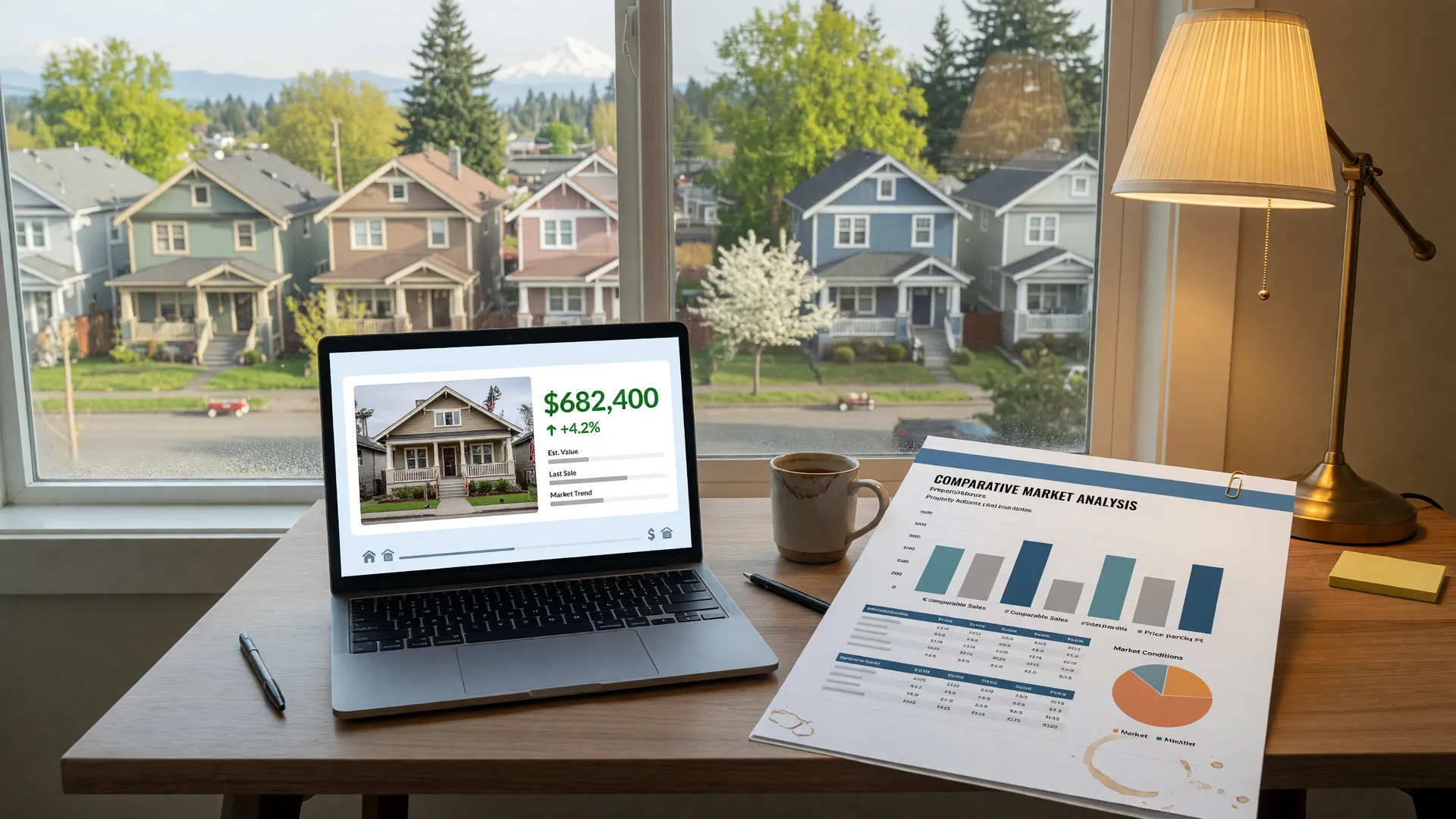
It is one of the first things homeowners do. You type your address into Zillow, and there it is, front and center: a number. Your Zestimate. It looks official. It looks precise. And a lot of people take it as the price a home is worth — whether they are selling or buying.
The reality? That number is a starting point, not a pricing strategy. Whether you are listing your home or making an offer, understanding what the Zestimate really tells you — and what it does not — can save you thousands of dollars.
Zillow's Zestimate is an automated valuation model. It's an algorithm that pulls public tax records, past sales data, and county assessor information, then runs it through a statistical model to generate a number. It does not walk through your home. It does not see the brand-new kitchen you installed last year. It does not know that your neighbor's house sold for more because it backs up to the park while yours doesn't.
Zillow itself acknowledges a median error rate of about 7-8% for on-market homes. On a $630,000 home in Tigard, that means the Zestimate could be off by $44,000 to $50,000 in either direction. That is a lot of money to leave to an algorithm.
The Zestimate can be $44,000 to $50,000 off on a median-priced Tigard home. And you have no way of knowing which direction.
If you are getting ready to sell, the Zestimate on your Zillow listing can feel like a gift — a number that tells you what your home is worth without having to ask anyone. But setting your list price based on that number is one of the riskiest moves a seller can make.
Here is why. A Zestimate does not know the specifics of your home. It does not walk through your front door and see the updated kitchen, the hardwood floors you refinished, or the curb appeal you worked on. It also does not see the deferred maintenance — the roof that needs replacing, the windows that are original to the house, or the furnace that could go any day. If the Zestimate undervalues your home, you could leave thousands of dollars on the table without ever knowing it.
Pricing too high based on an inflated Zestimate can be just as damaging. Your home sits on the market. Days on market creep up. Buyers start to wonder what is wrong. You end up cutting the price — often more than once — and chasing the market down instead of leading it. A home that sits too long sells for less, on average, than a home priced right from day one.
The right list price is not whatever Zillow's algorithm spits out. It is the price that reflects your home's actual condition, its place in the local market, and what buyers are willing to pay right now. That takes a professional CMA, not a website.
If you are shopping for a home, the Zestimate might look like a neutral fact-check on the list price. But it is not a reliable guide for making an offer either.
Say you find a home listed at $625,000 and Zillow shows a Zestimate of $600,000. You might assume the seller is overpriced and lowball your offer, only to discover that five other buyers recognized the home was under-listed and bid it up to $650,000. You lost the house because you trusted an algorithm over the market.
Or the reverse: the Zestimate says $650,000 on a home realistically worth $600,000. You offer full price, overpay by $50,000, and months later the appraisal comes back short or you are stuck in a home that will not hold its value. Buyers who rely on Zestimates risk either missing out on the right home or paying too much for the wrong one.
A Zestimate cannot tell you what a home is worth to you. It cannot factor in the school your kids will attend, the commute you will make every day, or the premium you would pay for a quiet street versus a busy one. Only a buyer's agent who knows the neighborhood and has run a real CMA can help you decide what a fair offer looks like.
A CMA — comparative market analysis — is what I put together for every client I work with. It is not an algorithm spitting out a number. It's a professional, data-driven assessment that accounts for what makes your home unique. Here are six things a CMA catches that Zillow simply cannot see.
Real estate moves in pockets. Two homes a mile apart can have significantly different values based on school district boundaries, walkability scores, park access, and nearby amenities. Zillow treats neighborhoods as one big geographic block. A local Realtor knows which streets command a premium and which ones don't — because I live and work in these communities every day.
A new grocery store, a popular restaurant opening, or a retail development can increase demand and drive property values up. A major employer leaving the area can suppress prices. Zillow's algorithm does not track business movement. A local Realtor pays attention to what is being built, what is closing, and what that means for home values in each pocket of the market.
When developers break ground on a new community, when the city invests in a new park or infrastructure project, demand shifts into those pockets. Stores closing or deferred maintenance in a neighborhood can depress values. A CMA captures these dynamics. Zillow does not.
How many buyers are actively searching right now? What are they willing to pay? Are homes getting multiple offers, or are they sitting? Zillow's estimate is backward-looking — it relies on closed sales that may be months old. A CMA factors in what is happening in the market today: bidding wars, fast sales, or a cooling trend. That real-time intelligence is something no algorithm can provide.
Zillow's algorithm has no idea whether your home has a brand-new kitchen or one from 1985. It doesn't know if the floors are refinished, the walls are freshly painted, or the landscaping is immaculate.
According to Zillow's own 2025 data, remodeled homes sell for a 3.7% premium while fixer-uppers are discounted by 7.3% — the largest discount in three years. On a $630,000 home, that is a swing of over $68,000. The National Association of Realtors, in a May 2025 report, found that 29% of agents saw a 1-10% increase in dollar value offered on staged homes.
A CMA factors in your home's actual condition relative to recent comparable sales. An algorithm just guesses.
Condition alone can swing your home's value by more than $68,000. That is not a number an algorithm can see.
Let's say the median home price in Tigard is around $630,000, according to Redfin and Movoto data. Let's walk through two scenarios:
Scenario A: You price below market. If a thorough CMA says your home should list at $655,000 but you follow Zillow's $630,000 estimate instead, you just left $25,000 on the table. That is real money — money that could go toward your next home, your retirement, or your family.
Scenario B: You price above market. If the CMA says your home is realistically worth $600,000 but you insist on listing at Zillow's $630,000, your home sits. Days on market pile up. Buyers start to wonder what is wrong with it. You end up reducing the price — often multiple times — chasing the market down instead of leading it.
Local median prices (Redfin/Movoto, 2025–2026): Tigard ~$630,000, Tualatin ~$633,000
To be fair, the Zestimate is not always wrong. Sometimes it lands within a reasonable range of the true market value. Zillow's algorithm processes a massive amount of data, and for homes in stable, homogeneous neighborhoods with recent, similar sales nearby, the estimate can be surprisingly close. If the stars align and your home is the "average" house on the "average" block, the Zestimate might match a CMA within a few thousand dollars.
The problem is that you have no way of knowing whether you are in that lucky group. Without a professional comparative market analysis, you are guessing — and guessing with a six-figure asset. The Zestimate could be spot on, or it could be off by $50,000, and there is nothing on the screen that tells you which one you are looking at. A CMA is the only tool that separates the signal from the noise and gives you a price you can trust.
Your Zillow estimate is a useful starting point. It gives you a ballpark. It gets you thinking. But it is not a pricing strategy.
A CMA is professional pricing built on local data, neighborhood knowledge, real-time market conditions, and boots-on-the-ground expertise. It accounts for your home's unique condition, the micro market it sits in, and what buyers are actually doing right now — not what a county database says happened six months ago.
When you are ready to sell, do not let an algorithm set the price for your most valuable asset. Call a Realtor who knows your neighborhood, knows the data, and knows how to put it all together.
Let's sit down and put together a CMA for your home. No algorithm, no guesswork — just real data and 30 years of experience.
Request a Free CMACreated with AI assistance